
Blog
How to Choose the Right Thickness for 28mm Flat Glazing Packers

Choosing the right thickness is one of the most important decisions when using 28mm flat glazing packers. The correct thickness helps keep the sealed unit level, properly supported, and accurately aligned within the frame. It also helps prevent common installation issues such as frame distortion, gasket stress, and rattling.
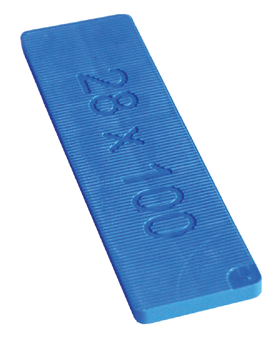
Our FP28 flat glazing packers are designed specifically for 28 mm glazing systems, made from polypropylene, and available in 1 mm to 6 mm thicknesses. That gives installers the flexibility to make anything from fine adjustments to more substantial load-bearing corrections.
What 28mm Flat Glazing Packers Are Designed For
We design our 28mm flat glazing packers to provide accurate spacing, reliable levelling, and consistent support in 28 mm glazing systems. Because they are non-compressible, they help maintain even support under sealed units without losing shape under load.
They are suitable for use in uPVC, aluminium, and timber installations and can be used across a wide range of applications, including windows, doors, conservatories, glazed units, and curtain wall systems.
Start by Assessing the Gap and the Support Needed
Before choosing a thickness, look at what the packer needs to do on the job. In most cases, the decision comes down to three things:
- the size of the gap
- the amount of support needed
- whether you are making a fine adjustment or a more structural correction
Our FP28 range is designed to cover this full spectrum, from light levelling and final alignment through to larger gaps and heavier load-bearing points.
When to Use 1mm FP28 Glazing Packers
Choose 1 mm packers when the unit or frame is already very close to the correct position and only a very small correction is needed.
We recommend 1 mm packers for:
- final alignment adjustments
- removing very small gaps
- fine-tuning after the main packing has already been done
This thickness is best when you do not want to significantly change the setup, only refine it.
When to Use 2mm FP28 Glazing Packers
Choose 2 mm packers when a slightly larger correction is needed but the adjustment is still relatively minor.
We typically use 2 mm packers for:
- slightly uneven surfaces
- small frame inconsistencies
- light levelling under glazing units
This is a practical choice when 1 mm is too little, but larger thicknesses would be more than the job requires.
When to Use 3mm FP28 Glazing Packers
Choose 3 mm packers for standard, everyday installation work.
We consider 3 mm one of the most useful all-round thicknesses for:
- general window installations
- standard levelling work
- typical glazing support
For many installers, 3 mm is the starting point because it suits a wide range of routine applications without being too light or too heavy.
When to Use 4mm FP28 Glazing Packers
Choose 4 mm packers when the gap or unevenness is more noticeable and a 3 mm packer does not provide enough correction.
We recommend 4 mm packers for:
- medium adjustments
- supporting heavier sections
- aligning slightly misaligned frames
This thickness works well when the job needs a bit more support than standard levelling.
When to Use 5mm FP28 Glazing Packers
Choose 5 mm packers when you need stronger support or need to take up a larger gap.
We use 5 mm packers for:
- larger gaps
- heavier sealed units
- more demanding structural levelling requirements
Where the unit is heavier or the opening is less even, 5 mm is often a better option than stacking smaller packers unnecessarily.
When to Use 6mm FP28 Glazing Packers
Choose 6 mm packers when significant support or spacing is required.
We recommend 6 mm packers for:
- large gaps or uneven openings
- high load-bearing points
- base packing under frames
This is the heaviest-duty thickness in our FP28 range and is best suited to installations that clearly need stronger support or greater correction.
A Simple Way to Choose the Correct Thickness
A straightforward way to choose the right thickness is:
- use 1–2 mm for fine adjustment and light correction
- use 3 mm for standard everyday glazing support
- use 4 mm for moderate unevenness or heavier sections
- use 5–6 mm for larger gaps, heavier units, or more demanding load points
This gives installers a practical framework for selecting the correct thickness without overcomplicating the process.
Avoid Choosing Thickness by Guesswork Alone
Our 28mm flat glazing packers are designed to provide consistent, non-compressible support and even load distribution. That means the aim is not simply to fill a space, but to support the sealed unit correctly.
If the packer is too thin, the unit may not be supported properly. If it is too thick, it can create unnecessary pressure, affect alignment, or make the installation more difficult than it needs to be.
The right thickness should always match the actual gap and support requirement of the job.
Why Trade Buyers Often Stock the Full 1mm to 6mm Range
Because our FP28 range covers 1 mm to 6 mm, trade buyers can handle everything from small final adjustments to heavier support work using one consistent product family.
That is especially useful for firms working across uPVC, aluminium, and timber systems, where support requirements can vary from one job to the next. Stocking the full range also reduces the risk of installers using the wrong size on site simply because the correct thickness is not available.
Final Thoughts
If you are choosing thickness for 28mm flat glazing packers, the best approach is to match the thickness to the actual correction and support needed on the job.
Use 1 mm and 2 mm for fine adjustments, 3 mm for standard glazing work, 4 mm for moderate alignment and levelling, and 5 mm or 6 mm where heavier units, larger gaps, or higher load-bearing points are involved.
Our FP28 range is designed specifically to cover that full progression, making it a practical choice for both everyday installations and more demanding applications.